This is the layer under the application layer. It is responsible for connecting the larger network to the end-user application.
Importantly, it does not transfer messages between hosts. It simply passes messages to and from the application to the larger inter-device network.
The transport layer has two protocols: TCP and UDP.
When more packets are sent than a network has bandwidth for, some of them start getting dropped.
Congestion actually occurs at the network layer (so between routers). However, it is caused by the transport layer sending too many messages at once, and so has to be repaired by the transport layer. This is also another example of the end to end argument.
Bandwidth can be allocated in one of two ways - per device (host) or per connection (application on the host). If we allocate per host, some hosts may have much higher bandwidth capabilities than what they're allocated - for example, google servers and a Ring doorbell are both independent hosts, and would have the same bandwidth allocation.
On the other hand, allocating per connection is quite effective, since if a process would like more bandwidth with another process, it can simply open up several ports on the host.
Bandwidth is therefore usually allocated per connection
In the real world, messages tend to not be uniformly distributed.
Packets are often sent in bursts, which means that statically and evenly allocating bandwidth amongst end-systems is not effective.
Below are some graphs of received transmission rate and delay as functions of sent transmission rate. We can see a critical point (transmission threshold) where these quantities do not plateau, but actually get worse.
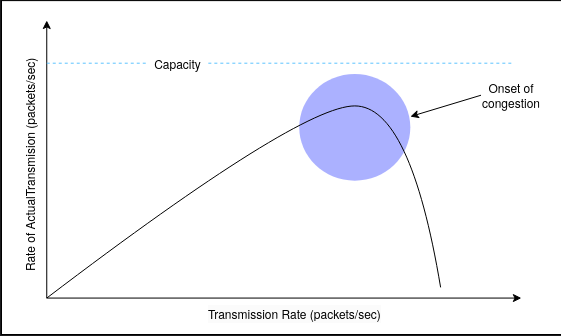
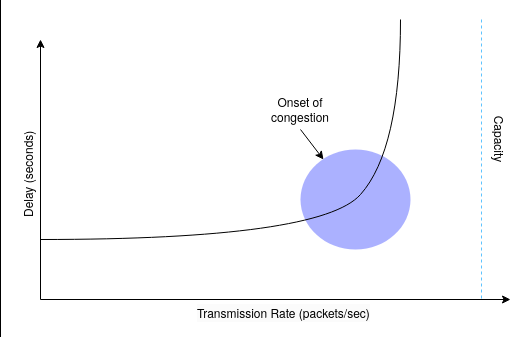
This worsening might be surprising for the transmission rate case (we would expect for the received rate to plateau towards the limit). This is due to spurious retransmissions, which occur when a message is re-sent after a transmission timer times out, even though the message is on the way but slowly. This results in a small number of packets being re-transmitting and hogging all of the bandwidth.
The optimal transmission rate maximises the power:
\[ P = \frac{R_T}{D(R_T)} \]For \(P:=\) power, \(R_T =\) transmission rate, and \(D =\) delay, which is a function of transmission rate.
The congestion scheme should be fair. Most congestion schemes aim at achieving max-min fairness. An allocation of transmission rates is considered to be max-min fair if